
President Trump Signs Wounded Knee Massacre Memorial and Sacred Site Act
By Darren Thompson
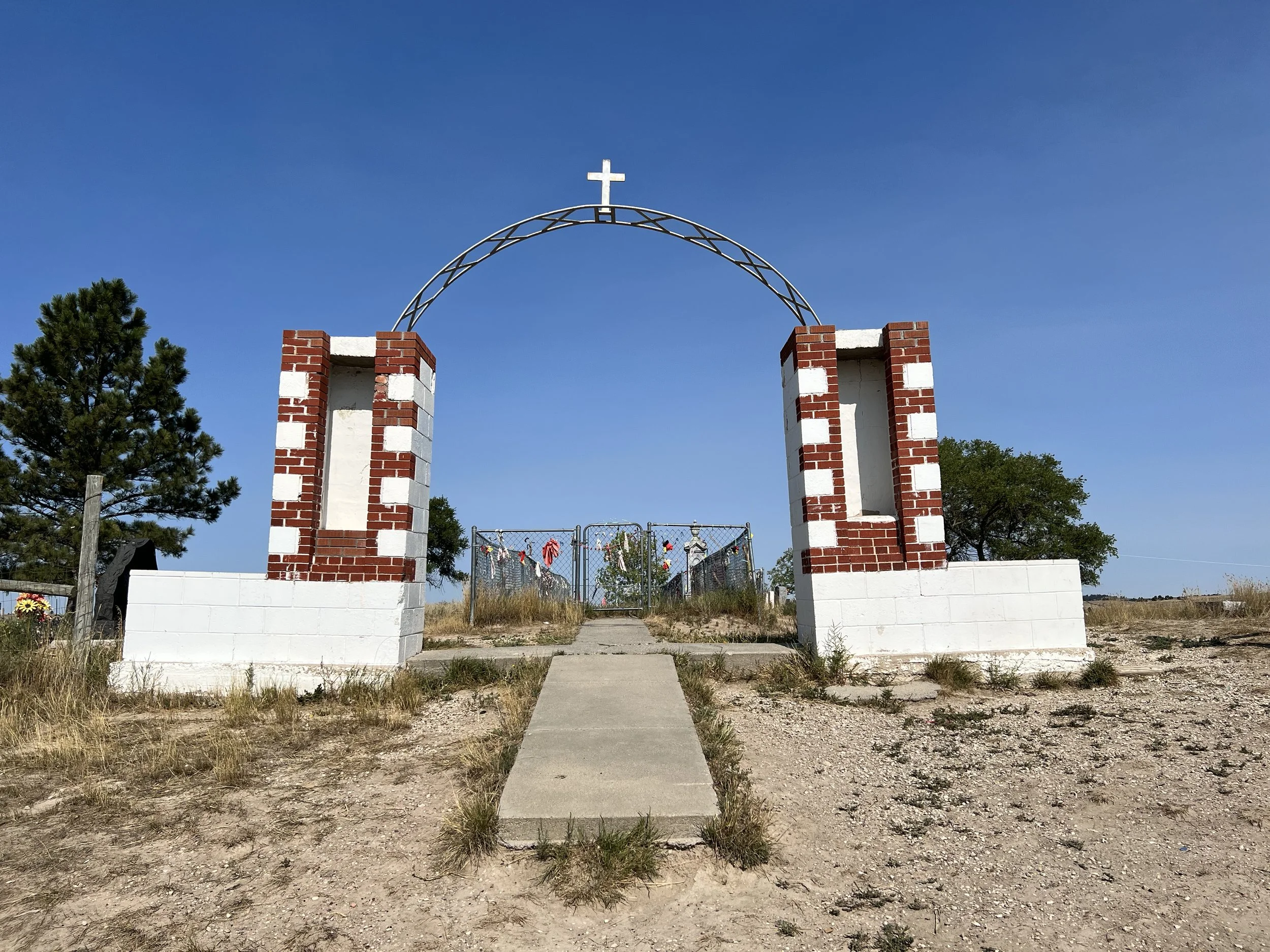
Washington—On Dec. 18, President Trump signed into law the Wounded Knee Massacre Memorial and Sacred Site Act, making the land around the Wounded Knee Massacre site restricted. The act was introduced by U.S. Representative Dusty Johnson (R-S.D.) in the House of Representatives and passed the House in January. The Senate version of the bill passed unanimously last week and was co-sponsored by Senators Mike Rounds (R-S.D.) and John Thune (R-S.D.).
“The Oglala Sioux Tribe and Cheyenne River Sioux Tribe are thankful and grateful that the 40 acres will now be protected from commercialization and be protected as a sacred site where much blood was spilled and lives lost there in 1890; many of the descendants of Massacre victims are still living with the trauma perpetuated on their relatives by killing and wounding them in the 1890 Massacre,” said Oglala Sioux Tribal President Frank Star Comes Out in a press release on Dec. 23.
The law places 40 acres adjacent to the Wounded Knee Memorial into restricted fee status, meaning no commercial development will be permitted near the memorial. Both the Oglala Sioux Tribe and the Cheyenne River Sioux Tribe purchased the land in 2022.
"This bill is an important step in the healing process for our Lakota people," said Star Comes Out.
When the Pine Ridge Reservation became allotted, as a result of the Dawes Act also known as the General Allotment Act in 1887, leaders say that allotment was a violation of the Fort Laramie Treaty of 1868. In the 1868 Treaty, any changes to land or the treaty required three-fourths consent from adult males of the Great Sioux Nation.
“The U.S. Government forced the 1889 Act on our tribes; they never got the requisite three-fourths adult male consent to make the 1889 Act legal as documented in U.S. District Judge Gladys Kessler’s opinion in Oglala Sioux Tribe v. Army Corps of Engineers, 537 F. Supp. 2d 161 (D.D.C.) 2008
After Congress passed the 1889 Act, aimed at dividing the Great Sioux Reservation, the Secretary of the Interior sent a three-member commission called the Sioux Commission to obtain the required acceptance and consent of the eligible Sioux males, which the Sioux Commission determined could be provided by the signing of a quit-claim deed. At that time, 5,678 adult male members (of the tribes] were eligible to give consent under article 12 of the 1968 Treaty and section 28 of the 1889 Act, 3,942 such that three-fourths approval would require 4,259 men to give consent.
While the Sioux Commission collected 4,463 signatures, they obtained no more than 3,942 valid signatures on quit claim deeds because at least 512 of those were invalid.
Oglala Sioux tribal members resisted allotments on the reservation from 1889 to 1904, but the Secretary of Interior ignored Section 9 of the 1889 Act and authorized allotments on the reservation by way of the 1903 Lonewolf v. Hitchcock decision in the Supreme Court. The Supreme Court denied that Congress has plenary power over Indian tribes and their lands, and as trustee for tribes, could violate treaties, agreements with tribes, and Acts of Congress such as Section 9 of the 1889 Act.
The acreage around the Wounded Knee Massacre site were illegally allowed to tribal members, and then ended up a fee patented lands to non-Indian owners, who then built and operated a trading post and museum to attract tourists to Wounded Knee Massacre Memorial.
“Not only is it outrageous that the U.S. military perpetuated the Massacre on our Indian people, it is also outrageous that we have to buy back our own land at the Massacre site," Star Comes Out said.
“The House, Senate and the President have agreed, so that we may remember and honor our relatives we lost at Wounded Knee, now and in future generations," said Cheyenne River Sioux Tribal Chairman Ryman LeBeau in a statement. "The Act and the Report also acknowledge the history of the Wounded Knee Massacre and America's Apology. On behalf of the Cheyenne River Sioux Tribe, we say Wopila, with special thanks to Representative Johnson, Senator Rounds and Senator Thune. This is a good day for our Lakota oyáté (people)!”
The bill directs the Department of the Interior to complete all actions necessary to place approximately 40 acres of land in Oglala Lakota County, South Dakota, into restricted fee status for the Oglala Sioux Tribe and the Cheyenne River Sioux Tribe. Restricted fee status refers to land that is owned by a tribe or tribal member but is subject to restrictions by the United States against alienation (i.e., sale or transfer) or encumbrance (e.g., liens, leases, or rights-of-way) by operation of law. The bill requires the land to be held and maintained as a memorial and sacred site, as outlined by the document titled Covenant Between the Oglala Sioux Tribe and the Cheyenne River Sioux Tribe and dated October 21, 2022. Further, it prohibits commercial development and gaming activity on the land.
“It has been almost 135 years to the day of the tragedy that unfolded at Wounded Knee and today, the president signed my bill into law to preserve the land where hundreds of lives were lost,” said U.S. Representative Dusty Johnson—the bill’s sponsor—in a press release on Dec.19. “I am grateful the Oglala and Cheyenne River Sioux Tribes will be able to hold this land in perpetuity as a way to honor and memorialize the lost.”
“The Wounded Knee Massacre not only represents a low point in U.S.- Lakota relations, but it also serves as one of the darkest moments in our nation’s history,” said U.S. Senator Mike Rounds in a press release on Dec. 19. “To date, the Wounded Knee Massacre grounds remain a symbolic site, with tribal members regularly visiting the area to honor the deceased. This legislation would keep this land in possession of the Oglala Sioux and Cheyenne River Sioux tribes to be protected and honored for generations to come.”
In the late 1880s, the Ghost Dance swept across many Indian tribes. Many Indian leaders believed that this dance would give stolen land back to the Indians, bringing about a renewal of many Native society. Indians would join together, wearing shirts they believed would protect them from bullets, to dance for this renewal, all at the protest of the federal government when Indian religions, dances, and culture were oppressed and outlawed.
On December 29, 1890, a group of Lakota Indians led by Chief Spotted Elk had made camp near Wounded Knee Creek on the Pine Ridge Indian Reservation in South Dakota. There, U.S. Army 7th Calvary troops were sent to disarm the Lakota. A struggle occurred between the U.S. Army and some of Chief Spotted Elk's band - a majority of which consisted of women and children. A shot rang out, and the U.S. Army opened fire on the largely unarmed group, massacring up to 350-375 Lakota Indians. Twenty-five U.S. soldiers also died.
A celebration is planned for Monday, December 29, 2025 at the Wounded Knee Massacre Memorial site in Wounded Knee, South Dakota, and South Dakota’s congressional leaders will be in attendance along with many Oceti Sakowin leaders, and the Bureau of Indian Affairs Deputy Assistant Secretary of Indian Affairs Scott Davis.