
Trump Administration Officials Address Coalition of Large Tribes’ Annual Meeting
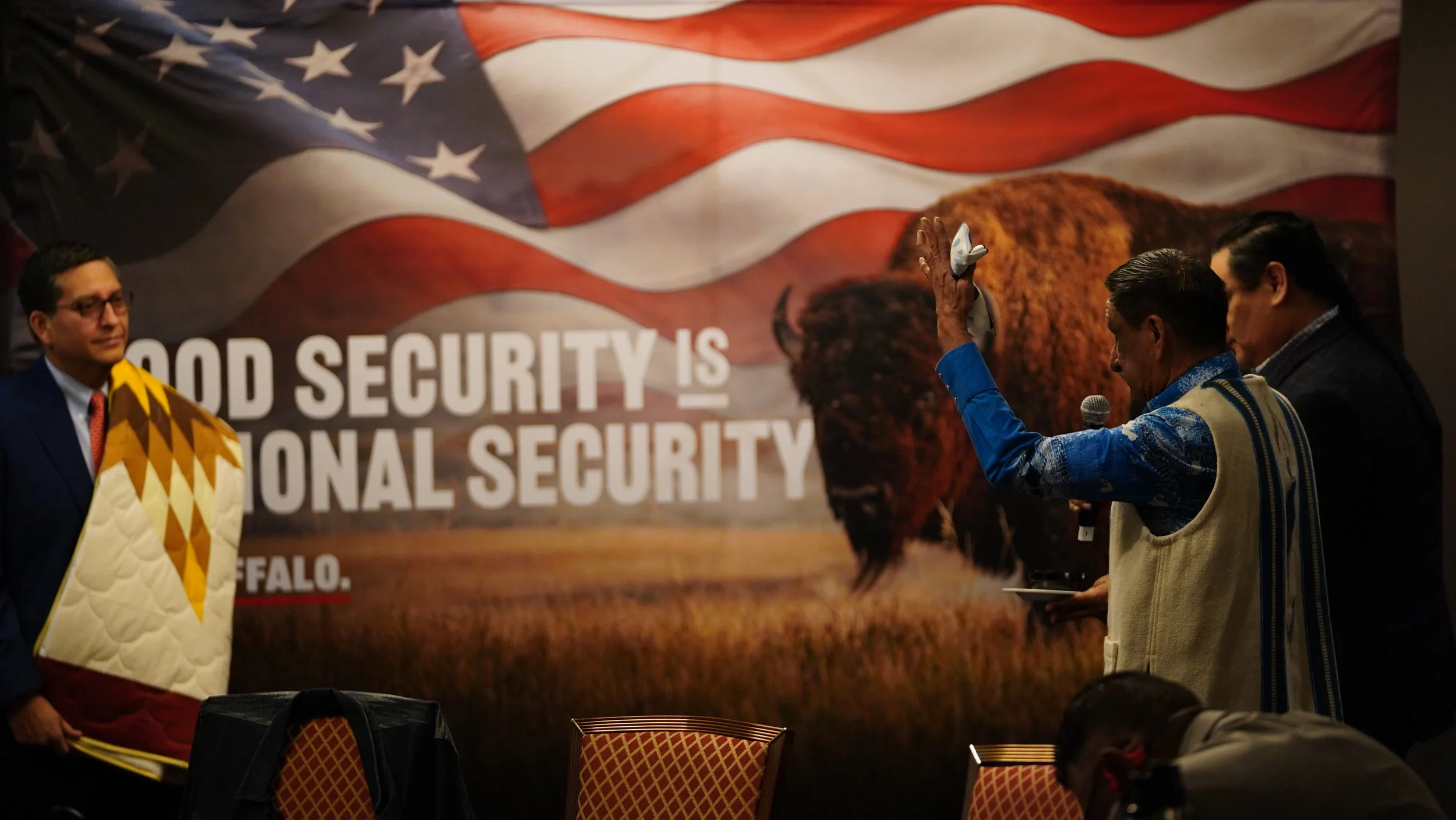
Assistant Secretary of Indian Affairs Billy Kirkland (left) is gifted a star quilt by tribal leaders attending the Coalition of Large Tribes (COLT) and Apsaaloke (Crow) elder Robert Flat Lip offered a prayer to Kirkland after Kirkland presented the agency’s agenda at the three-day meeting. Photo by Darren Thompson.
By Darren Thompson
Las Vegas—This week, senior officials from the Trump administration addressed tribal leaders at the Coalition of Large Tribes’ (COLT) annual meeting in Las Vegas. COLT is a membership organization composed of federally recognized and treaty tribes that have more than 100,000 acres of tribal lands, and strategize of how to best navigate the federal government's unique programs for Indian Country. Tribal leaders have the opportunity to hear from cabinet members about issues that tribes have to navigate in the current administration. It also presented an opportunity for tribal leaders to address senior officials directly.
Tribal leaders brought up their concerns to Assistant Secretary of Indian Affairs Billy Kirkland, Senior Counselor to the Department of Health and Human Services (HHS) Secretary Robert Kennedy Jr., Mark Cruz, Treasurer of the United States Brandon Beach, and U.S. Senator Catherine Cortez Masto regarding funding for law enforcement, the government shutdown, the cost of food, taxes, the targeting of tribal citizens by Immigrations and Customs Enforcement (ICE), and the National Defense Authority Act (NDAA).
“Funding should be mandatory, not discretionary,” said Nathan Small, of the Shoshone Bannock Tribes, when in discussion with Mark Cruz. “We all have this sticker in front of us that says, ‘Honoring Indian Treaties’ and if our health isn’t well, you're not honoring the treaties.”
Earlier this year, the Trump administration offered buyouts to federal employees, and many working in Indian Country took the offer, leading to a greater shortage of Indian Health Service (IHS) workers. IHS is the federal agency that solely exists to provide healthcare services to federally recognized tribes and their enrolled members, and has had a decades long staff shortage of at least 20%. Currently, the IHS staff shortage is above 30% according to a statement made by HHS Secretary Kennedy.
Cruz reached out to tribal leaders and said that IHS needs help finding an acting director for the health agency. Two weeks ago, Sec. Kennedy announced that HHS appointed Clayton Fulton, the agency’s chief of staff, in the position of the IHS director, until someone fills the position.
“We’re looking for someone that has the requisite experience, but also is aligned with President Trump, its Secretary Kennedy, and that can make it through a U.S. Senate confirmation process,” Mark Cruz said via Zoom. “We also need more Native physicians, more Native nurses, more Native builders, people at the front desk. Our IHS has a hiring problem and they’ve had this 30% vacancy rate and with hiring changes that have gone on in 2025, it's made hiring harder. And only Indian country can help us solve this problem.”
“For people who are to be hired I'm not quite sure why it takes so long,” said Nathan Small, a tribal council member from the Shoshone Bannock Tribes in Idaho, to Mark Cruz. “In some cases it takes six months or longer to get somebody into a position with us, and because it takes so long, they're moving on. They can't wait six months so long to wait to see if they got a job. So, then, you have to start all over again.”
In addition, other areas of funding have either been proposed and some have been cut, including freezes and reductions in funding for education, like tribal colleges, law enforcement, housing, food security, and environmental initiatives. The results of have led to lawsuits against the administration from across Indian Country and tribal leaders consistently in Washington D.C. to meet and discuss the unique needs of each tribal community.
Alfred LaPaz, a Mescalero Apache tribal council member addressed the recent actions by Immigration and Customs Enforcement (ICE) and the reduction in funding for the Bureau of Indian Affairs (BIA). “Law enforcement has gone crazy down there [in Albuquerque] and we used to have our superintendent in charge at the agency of BIA law enforcement. Now they took that away and they're out of Albuquerque, which is 200 miles north of us. They're doing whatever they want. They have no supervision down there. I mean, they do, but it's just going crazy.”
Now, his community, in southern New Mexico, has conservation officers providing law enforcement responsibilities to the reservation. “They’re doing a lot of the work and taking over a lot of the responsibilities for our law enforcement,” said LaPaz. "I don't know what's going on with BIA. They're neglecting their duties, their jobs, their calls, and whatever happens—conservation is taking care of it, and some of them aren't are not certified by the state or somebody's gonna get hurt.”
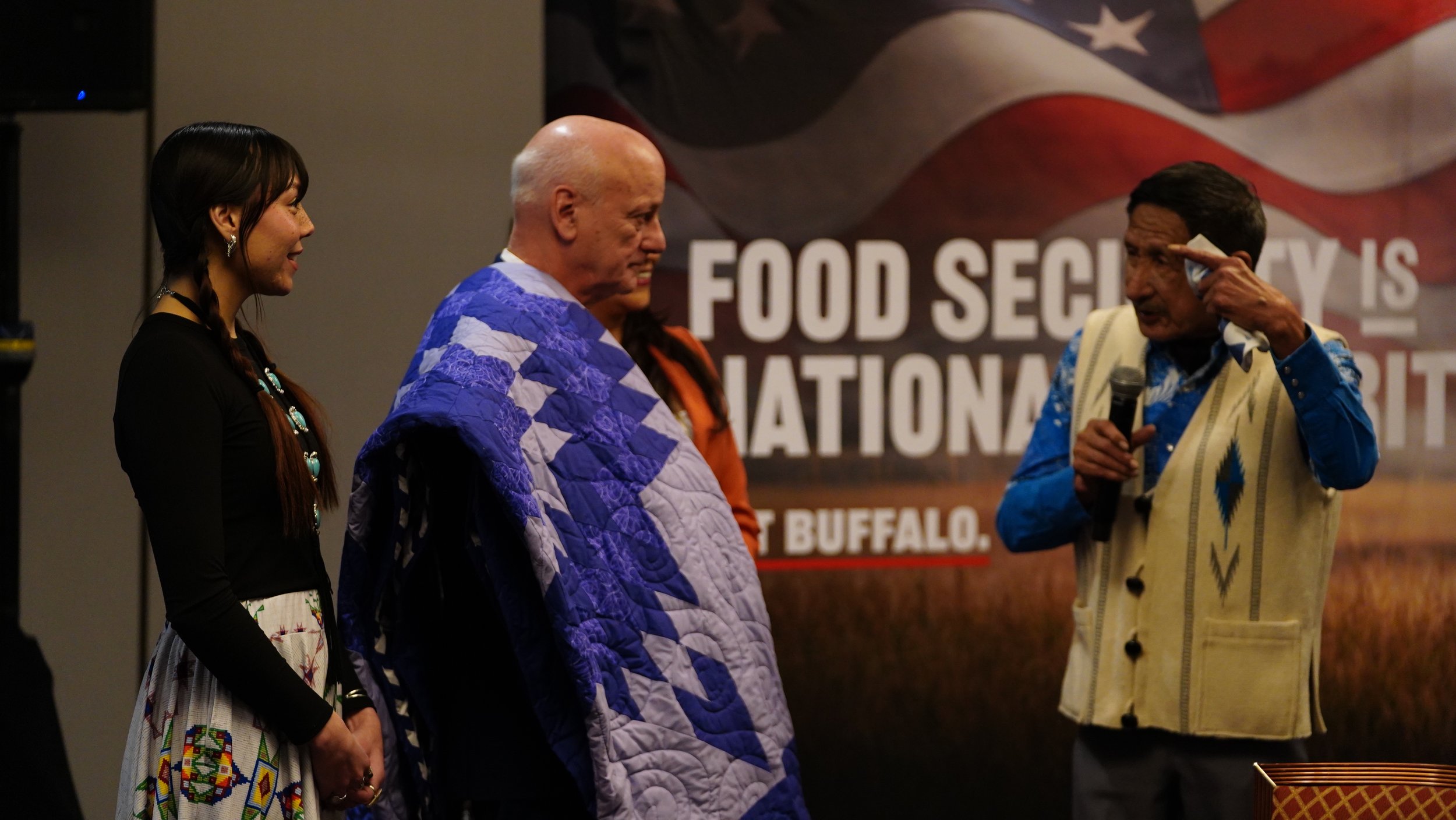
U.S. Treasurer Brandon Beach was gifted a star quilt by tribal leaders for attending the Coalition of Large Tribes’ annual meeting in Las Vegas on Dec. 8, 2025. Photo by Darren Thompson.
The U.S. Treasurer Brandon Beach shared several aspects of developments for Indian Country, including not to label local tribal Community Development Financial Institutions (CDFI) as diversity, including or equity initiatives. “We want to make sure that there was the CDFIs work not only in urban parts of of the country, but for you guys, and make sure that y'all aren't classified as a DEI and that you all can get these loans and the capital you need to grow businesses,” he said. “I think there's way more opportunities in the Indian Nation than there are challenges. We can overcome the challenges, but if you all are real willing to work hard and use the tools that we're going to give you on taxation, I think there's a lot of opportunity for growth and prosperity.”
CDFIs are specialized financial service providers that invest in low-income communities and traditionally underserved populations. There are more than 70 CDFIs in Indian Country, and they serve communities in 27 states, including Alaska and Hawaii. CDFIs offer flexible loans and financial products where traditional banks often don't, including for startups, small businesses, and housing while receiving funding from the U.S. Treasury Department.
The $900 billion National Defense Authorization Act (NDAA) was also discussed, particularly about the inclusion the Lumbee Tribe of North Carolina’s effort to achieve federal recognition. The NDAA includes language that would recognize the North Carolina based Lumbee Tribe of Indians as a federally recognized tribe—a controversial topic that would instantly make more than 60,000 people at 4/4’s, or full-blood, recognized as American Indian. The Lumbee Tribe has nearly 60,000 members, and both Trump and Democratic candidate Kamala Harris promised the Lumbee federal recognition during the 2024 campaign. In the early days of his second presidency, Trump issued an executive order directing the Interior Department to create a plan for federal recognition for the Lumbee.
“We continue to have major concerns with the cost of this bill, and the cost of this bill will require a five year period for this group as well over $2 billion,” said Michell Hicks, Principal Chief of the Eastern Band of Cherokee Indians. “And I know that's a concern, I mean, it's a group that doesn't have any prior treaties, that have no language, that has had no land base, and they have not proven their true identity.”
The House plans to vote this week, but the inclusion of the federal recognition of the Lumbee Tribe of North Carolina isn’t guaranteed. If passed, the tribe would suddenly be one of the largest populated tribes in the country and would bring federal dollars, including the building of a casino, to rural North Carolina.
“A lot of things that we're able to accomplish, even though they are for large land based tribes, affects all tribes," said COLT Executive Director OJ Semans.
COLT’s member tribes are Blackfeet Nation, Cheyenne River Sioux Tribe, Confederated Tribes of the Colville Reservation, Confederated Tribes of the Warm Springs Indian Reservation of Oregon, Crow Creek Sioux Tribe, Crow Nation, Eastern Shoshone Tribe, Fort Belknap Indian Community, Mandan, Hidatsa & Arikara Nation, Muscogee (Creek) Nation, Navajo Nation, Northern Arapaho Tribe, Northern Cheyenne Tribe, Rosebud Sioux Tribe, San Carlos Apache Tribe, Shoshone-Bannock Tribes, Shoshone-Paiute Tribes of the Duck Valley Indian Reservation, Sisseton Wahpeton Sioux Tribe, Spirit Lake Nation, Spokane Tribe, Standing Rock Sioux Tribe, Ute Indian Tribe, Ute Mountain Ute Tribe, and the Walker River Paiute Tribe. The organization is a consensus nonprofit organization, meaning they only push forward issues that each tribal leaders agrees with.
Darren Thompson is the Managing Editor of Last Real Indians Native News Desk and the Director of Media Relations for the Sacred Defense Fund, an Indigenous-led nonprofit organization based in Santa Fe, New Mexico. He’s an award winning multimedia journalist enrolled at Lac du Flambeau Band of Lake Superior Chippewa, where he grew up. He can be reached at darren@sacreddefense.org.